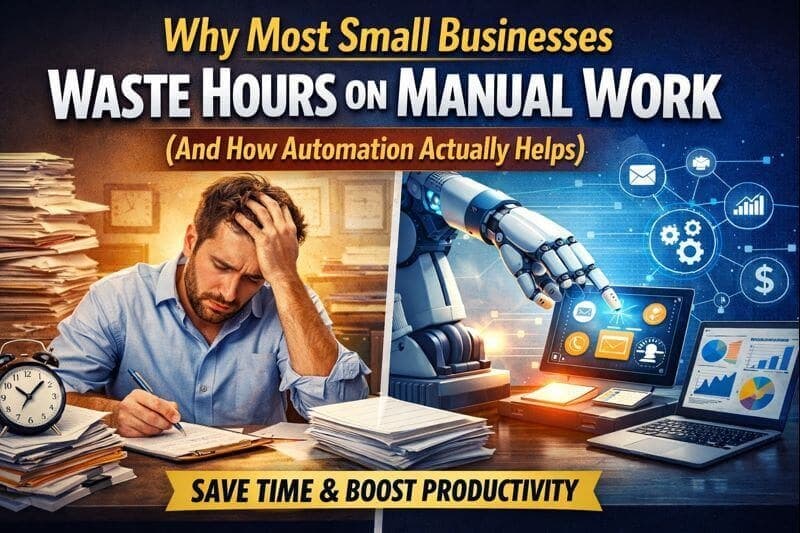
Why Most Small Businesses Waste Hours on Manual Work (And How Automation Actually Helps)
Introduction: The Hidden Cost of Manual Work for Small Businesses
In today’s fast-paced world, time is the most valuable asset for small business owners. Yet, many spend countless hours buried under manual tasks—processing invoices, entering data, replying to repetitive emails, or scheduling social media posts. These time-consuming activities not only sap productivity but also prevent owners from focusing on growth and innovation.
According to research by Zapier, nearly 90% of small business employees perform repetitive tasks daily, with 66% saying they’d benefit from automation. But the question remains—why do so many businesses still rely on outdated manual processes?
Why Small Businesses Still Rely on Manual Processes
Lack of Awareness About Automation Tools
Many small business owners simply don’t know what automation can do. They might think it’s something reserved for large corporations with big budgets and IT teams. In reality, modern tools like Zapier, Make (Integromat), and HubSpot offer affordable and user-friendly solutions for even the smallest operations.
Fear of Complexity and Cost
Another common barrier is fear—fear of technology, fear of setup costs, and fear of breaking something that “sort of works.” But the truth is, most automation platforms today require no coding skills and offer free tiers or low monthly subscriptions.
“If It’s Not Broken, Don’t Fix It” Mindset
This mindset holds many businesses back. Just because a process works doesn’t mean it’s efficient. Manual work may not seem broken—but it’s quietly draining your resources, time, and potential.
How Manual Work Hurts Productivity and Growth
Time Drain: The Invisible Business Killer
Manual work steals hours that could be spent on strategy, marketing, or customer relationships. A simple task like manually sending invoices or updating spreadsheets can take hours each week. Over a year, that adds up to hundreds of lost hours—time that could have been invested in scaling your business.
Employee Burnout and Decreased Motivation
Employees stuck doing repetitive work are less engaged and more prone to burnout. Automation frees them from mundane tasks so they can focus on creative, strategic, and high-value activities.
Lost Opportunities Due to Inefficiency
While competitors leverage automation to move faster, manual processes slow your business down. You might miss out on leads, fail to follow up with customers promptly, or take too long to deliver—costing you valuable business opportunities.
Common Areas Where Small Businesses Waste Time
Here’s where most of that wasted time goes:
- Accounting and Invoicing – Manual entry, reconciliation, and billing eat up hours. Tools like QuickBooks or Xero automate these easily.
- Customer Support – Repetitive inquiries that can be handled by chatbots or automated ticket systems.
- Marketing and Social Media – Scheduling posts manually instead of using tools like Buffer or Hootsuite.
- Inventory Management – Updating stock levels manually instead of syncing across platforms.
- Reporting – Manually compiling data from multiple sources when it can be auto-generated with one click.
What Is Business Automation and How Does It Work?
Automation refers to using software or tools to perform repetitive tasks automatically—with little to no human intervention. For example, when a new lead fills out a form on your website, automation can:
- Add their info to your CRM.
- Send a personalized welcome email.
- Notify your sales rep automatically.
Integrations and APIs
Most tools communicate through APIs—allowing different systems to “talk” to each other seamlessly. That’s how automation connects your accounting software, CRM, and marketing tools effortlessly.
Key Benefits of Automation for Small Businesses
- Increased Efficiency – Tasks that took hours can now take minutes.
- Reduced Errors – Automated systems don’t make typos or forget deadlines.
- Cost Savings – Save money by reducing labor-intensive work.
- Improved Customer Experience – Faster responses and consistent service.
- Smarter Decisions – Access to real-time data helps owners make informed choices.
Best Automation Tools for Small Businesses in 2025
| Category | Tool | Main Use |
|---|---|---|
| Workflow Automation | Zapier / Make | Connect and automate multiple apps |
| CRM & Marketing | HubSpot / ActiveCampaign | Automate customer follow-ups |
| Accounting | QuickBooks / Xero | Simplify finance management |
| Project Management | Trello / Asana | Automate task tracking and reporting |
How to Start Automating Your Business (Step-by-Step Guide)
- Identify Repetitive Tasks – List tasks you or your team repeat daily or weekly.
- Choose the Right Tools – Pick automation platforms that fit your needs.
- Start Small – Automate one or two processes first.
- Train Your Team – Ensure everyone understands the new systems.
- Monitor & Optimize – Track performance and improve over time.
Common Myths About Automation (Debunked)
- Myth: Automation replaces human jobs.
Reality: It frees humans to focus on higher-value tasks. - Myth: It’s too expensive.
Reality: Many tools are free or affordable for small teams. - Myth: It’s too complicated.
Reality: Most modern tools are no-code and beginner-friendly.
FAQs
1. What tasks can be automated in a small business?
Anything repetitive—like data entry, follow-up emails, invoicing, and report generation.
2. Is automation expensive?
Not anymore. Many tools offer free plans and flexible pricing.
3. Will automation replace jobs?
No. It enhances productivity, allowing teams to focus on creative and strategic work.
4. How do I start automating?
Begin with simple workflows, like automating email responses or invoice creation.
5. Can automation work with my current tools?
Yes! Most automation platforms integrate with thousands of apps.
Conclusion: The Future Belongs to Automated Small Businesses
The future of small business isn’t about working harder—it’s about working smarter. Automation isn’t just a convenience; it’s a competitive advantage. Those who adopt it early will save time, cut costs, and scale faster than those who don’t.
Start small. Automate one process today—and you’ll wonder how you ever ran your business without it.